


Actually, EB-1A, EB-2 NIW, and O-1A, as statutory categories, are really high standards. It truly requires extraordinary skills to receive these visas. EB-1A is so special that only a few are able to crack it, and definitely it requires extraordinary qualifications. At the same time, it needs very strong evidence.
When people talk about success in extraordinary ability visas EB‑1A, EB‑2 NIW, or O‑1A they often describe it as a “paper chase.” They think evidence can be gathered anytime, and the right presentation will unlock the door. But that’s an illusion.
Timing is more important than most people realize.
We often think that evidence can be extracted or prepared at any time. But now I strongly believe that this journey requires planning. Evidence is not something you extract on demand. It’s something you grow over time like harvesting from a tree that took years to plant. Each piece of proof, each recognition or publication, forms part of a much longer story of credibility. .It is something you grow over time.
These visa categories, particularly EB‑1A represent the upper tier of merit recognition. They require extraordinary ability, sustained acclaim, and original contributions that matter. The truth is, very few manage to crack it. EB‑1A sits in that special zone where qualifications and documentation must align with almost artistic precision. You can’t improvise your way through. You build it. You live it.
I began my own extraordinary journey in early 2023.
By nature, I’m what I call an extrovert processor or, in simpler terms, an oversharer. I speak my thoughts out loud. I share ideas early long before they’re perfect because it helps me refine them and stay motivated. When I started my EB‑1A journey, I openly discussed what I was learning with friends and colleagues.
Almost no one took me seriously.
I have a story of my friend and colleague who received his I-140 approval at the most needed time in his life. But it could have been very helpful if he had put that effort a little earlier.
Basically, I started this extraordinary journey in the beginning of 2023. I shared with him almost everything for two reasons: for suggestions and for motivation.
I shared my journey in the beginning to get suggestions. Even my close friend did not take it seriously. He shrugged when I mentioned I was applying for a professional membership. We worked in the same company, under the same manager, in the same field but with different skills, personalities, and outlooks. When I talked about it to him, he said, “I don’t know how that works. Tell me how it goes.”
That was his tone every time I shared something new: indifferent, curious, but detached.
Here’s something I’ve learned “If you have any individual with porous boundaries around you, it is better to lend your ears if the information is relevant and useful”. Because when that person succeeds, they’ll move on to something else, and you’ll miss your chance to learn from the window of relevance.
Until my I‑140 approval, my friend didn’t start his journey. Maybe he thought it was too uncertain, too complicated, or not worth the effort. But once my case got approved, everything changed. He realized the path was real, tangible that someone like him could achieve it too. He started gaining confidence that this path works.
That’s when he began his own journey.
Then I shared my information about the product that I am building for individuals like us. I told him clearly that I will be on your side. “Help” or “guide” is not the right word. I cannot help others in that journey in a professional sense, but I can be on their side.
Around the same time, I was also building the platform for people exactly like us. It was to create a system that helps individuals understand and measure their accomplishments with clarity before they even approach law firms.
When I told my friend about the product, I said, “I’ll be on your side.” And I meant it.
But I also clarified something very important: ‘Help’ or ‘guide’ is not the right word. Because the moment I start helping professionally, I become an agency. And that’s not my calling.
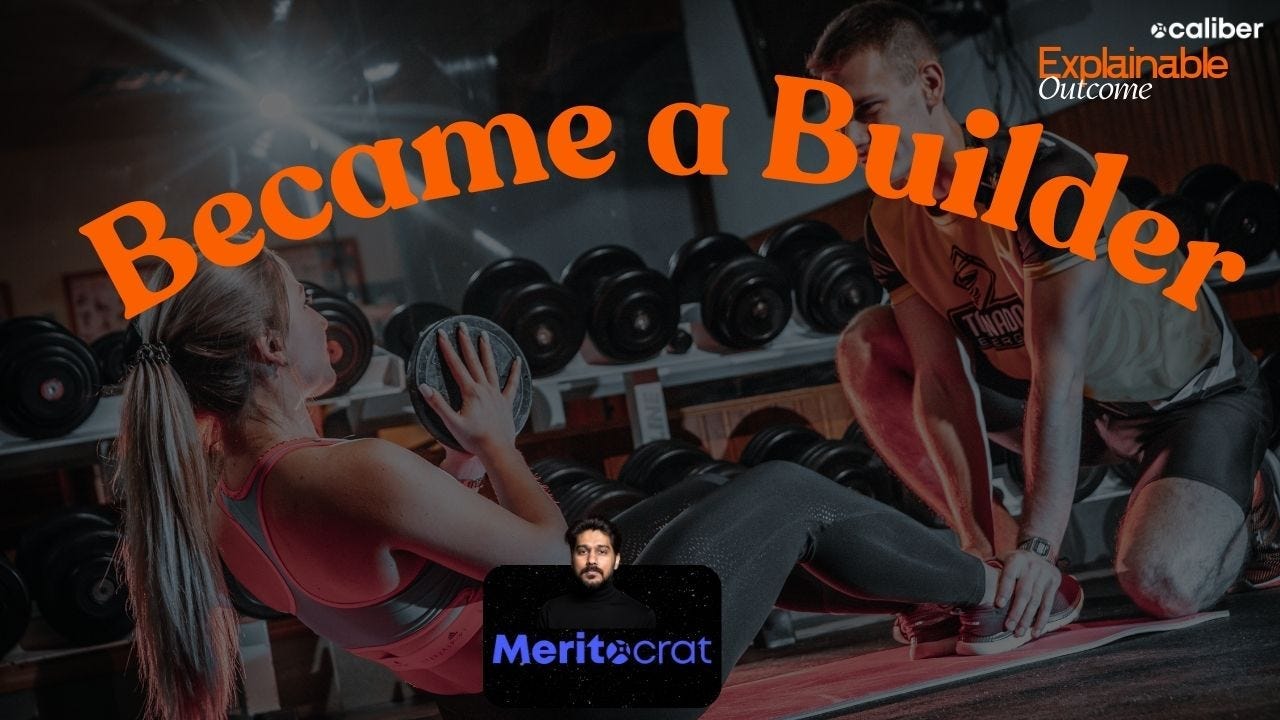
To explain it, I use a simple analogy. Imagine I’m a developer who happens to be overweight. If I lose weight successfully, I have two choices, I can become a trainer or nutritionist after formal education, or I can build an app that helps others do it themselves. Builders create tools. Achievers create motivation and fellowship service. Both are valuable, but they play different roles.
I want to be a builder.
Please read this story written by Michael Karsten:- “Why This Fat Developer Said ‘Screw Your Subscriptions’ and Built His Own If App”. The developer didn’t create a company to sell fitness programs. He built a product that solved his own problem and ended up helping thousands. That story shaped how I view my role in the immigration space — I’m not a consultant, I’m a builder of systems that help people think.
Follow

Before: When my only successful tracking was my pizza delivery app usage
So when my friend finally began his process, I told him one simple thing: whatever evidence you gather, keep it mapped to your own profile. Understand your trajectory. That’s exactly what Meritocrat does but in a refined, structured way.
Our entire system is built on binary questions that measure two essentials: strength and impact. Those are the cornerstones of any evaluation.
I told him to focus on four main criteria, especially original contributions and critical roles. He started exploring opportunities to review judging panels and to publish scholarly work related to his field. Just two or three judging experiences, and two or three publications or connections through scholarly channels, can be powerful evidence.
He managed to secure two judging engagements and two scholarly links tied directly to his work. That alone began shaping a strong case. He built very strong evidence around his profile.
But still during the journey, there were many places where he could have strengthened his case. Independent expert opinion letters. HR letters highlighting his role. These are all important. Either he did not get them or he avoided the expenses related to them. We never know which piece helps and which does not. Sometimes it was very hard to say that those are important. He said he was going to check his luck.
Together, we collated his entire evidence list, arranged it by priority, and decided he should go to an attorney. That’s always the principle behind Meritocrat, provide the structure to the profile and reach out to legal guidance.
We never know which piece helps and which does not.
For Meritocrat, he was a manual trial.
For him, it was an attempt at luck.
He filed around November 2024, about a year after my own approval.
Then came the RFE.
Almost everything was questioned every claim, every document.
And as if life wanted to test him twice, he got laid off at the same time. It was a brutal period for him and uncertainty on all fronts.
I urged him again to get attorney support. He consulted two attorneys and picked one to get a proper legal opinion about his case. That attorney’s feedback was precise:
Obtain a detailed HR letter that clearly outlines your role that how it is different from others and your contributions.
Add more evidence showing original work and innovation.
Secure a proper expert opinion report.
These expert reports, especially the paid ones facilitated through attorneys, are legitimate tools in USCIS cases even in H‑1Bs where educational equivalency or occupational expertise must be shown.
We worked together again, refining the RFE response. We built context, attached evidence where gaps existed, reviewed it multiple times, and aligned everything with the attorney’s recommendations. It was intense, but this time everything fit together. We reviewed it with the same attorney.
He got his approval.
That moment was deeply meaningful not just for him, but for me too. There was a hidden blessing in his struggle. He could have avoided many mistakes if he’d started earlier or planned better. But those mistakes became teachers showing him the importance of foresight, documentation, and timing.
And they reinforced my strongest belief:
I do not want to be an agency.
I want to be a builder.
Agencies file cases.
Builders create systems.
Agencies guide people step by step through existing frameworks. Builders design new frameworks that allow people to guide themselves -intelligently, independently, and confidently.
That’s why Meritocrat exists.
It is meant to enhance your work along with attorney’s guidance.
It is meant to prepare individuals so that when law begins, clarity already exists.
In a way, that’s the deeper difference between consultants and builders. Consultants interpret systems that already exist. Builders create systems that didn’t exist before.
I believe that’s why some EB‑1A recipients become consultants and they teach what they’ve mastered. But Some recipients become the builders, often turn their journeys into platforms, tools, ideas, and systems because their instinct is not just to advise, but to engineer solutions.
And that, to me, is the quiet beauty of this journey. It’s not only about reaching the extraordinary bar, it’s about building your own ladder to get there, and then leaving it behind for someone else to climb.