


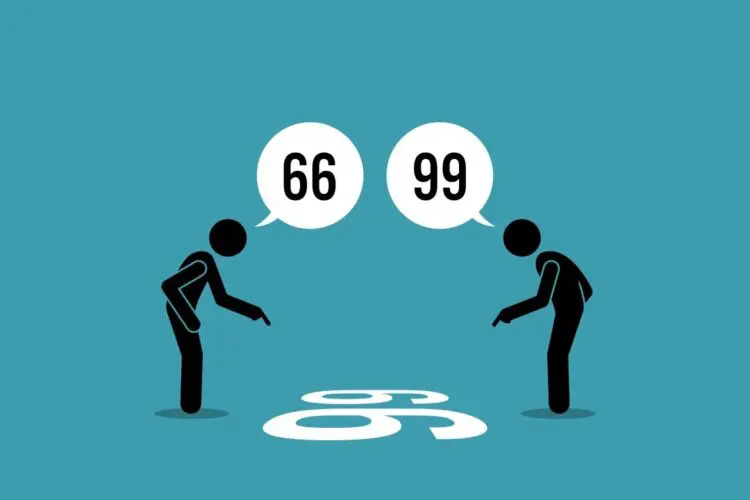
For decades, companies have believed that the best product wins. Better features. Better performance. Better pricing. Yet history shows again and again that the market does not reward the most technically superior offering. It rewards the product that wins in the mind.
Marketing is not a battlefield of products competing on spreadsheets. It is a battlefield of perceptions competing for belief.
People Buy Meaning Before Mechanics
Customers rarely evaluate every option objectively. They make decisions based on belief. Trust, familiarity, clarity, and emotional alignment shape their choices long before features are compared.
Choice 1: A product that is hard to explain feels risky.
Choice 2: A product that feels familiar feels safe.
Choice 3: A product that fits someone’s identity feels inevitable.
Perception answers the unspoken question every buyer asks: “Does this make sense for someone like me?”
The Law of Perception
In the battle for prospective customers’ minds, you must fight not only to be first in mind but also best in mind. Contrary to popular belief, the Law of Perception says that your most potent weapon in marketing is not the quality of your product, but rather the public’s perception of your product. Simply put, perception is reality: No matter what research and performance tests reveal, your marketing will only be successful if consumers believe that your product is the best. Have you ever tried to get someone to change her mind about something she was absolutely convinced was true? You can throw every fact at the person and, still, if someone is convinced that something is true, then it is—at least, it’s true in her mind, and that’s all that matters.
This article is an excerpt from the “The 22 Immutable Laws of Marketing” by Al Ries and Jack Trout.
Positioning Creates Reality
Positioning is not about exaggeration. It is about choosing what to emphasize so the audience understands where you belong.
When you define your category clearly, comparisons become favorable by default. When you fail to define it, the market does it for you, often incorrectly.
Law of Category is an another topic in Marketing.
Strong positioning simplifies decisions. It tells people what to ignore and what to focus on. Weak positioning forces them to work harder, and most will walk away instead.
Clarity Builds Trust Faster Than Claims
Trust is rarely built through bold promises. It is built through clarity.
When people immediately understand:
what you do,
who it is for,
and why it exists,
they assume competence. Confusion, on the other hand, creates doubt, even if the product itself is excellent.
Clear perception reduces perceived risk. Reduced risk accelerates adoption.
These are just two examples that illustrate how perception trumps product quality:
Japanese carmakers sell Honda, Toyota, and Nissan in both Japan and the United States. Given that the quality, design, and power of the cars are identical in both countries, and the prices are nearly the same, the best-selling car should be the same in both places. However, while Honda trails behind Toyota and Nissan in Japan, it sells far more cars in the U.S. Honda is considered a quality car company in the U.S., but Japanese customers perceive Honda primarily as a motorcycle manufacturer, and they don’t perceive a motorcycle company to be a source for high-quality cars.
When the Coca-Cola Company introduced New Coke, it conducted a taste test among 200,000 people that revealed that New Coke had the best taste, followed by Pepsi, followed by Coca-Cola Classic. However, the sales were reversed: Coca-Cola Classic had the highest sales, followed by Pepsi, with New Coke last. If product quality truly determined marketing success, the sales should correlate with the taste test data.
Why This Matters More Than Ever
In a world flooded with AI tools, platforms, and products, differentiation through features alone is temporary. Features can be copied. Interfaces can be replicated. Pricing can be undercut.
Perception is harder to steal.
The brands that win are not those shouting the loudest, but those that are understood the fastest.
The Real Competitive Advantage
Marketing success comes from answering one question better than anyone else:
“What should people believe about us?”
When perception is clear and credible, products no longer need to fight. They simply fulfill expectations that have already been set.
In the end, markets do not choose the best products.
They choose the best understood ones.
In the end, markets do not choose the best products.
They choose the best understood ones.