Why open source matters here
I come from an open source background. I work with products built on Apache and other open ecosystems because I believe technology grows healthier when more people can read it, adapt it, and build on it, not just consume it. When everything becomes proprietary, we shrink the circle of people who can learn, improve, and meaningfully participate in the systems that affect their lives.
That is why, when I first started building what later became Meritocrat, I released xoCaliber as an open source project.
https://github.com/XO-Caliber/xo-caliber-v1
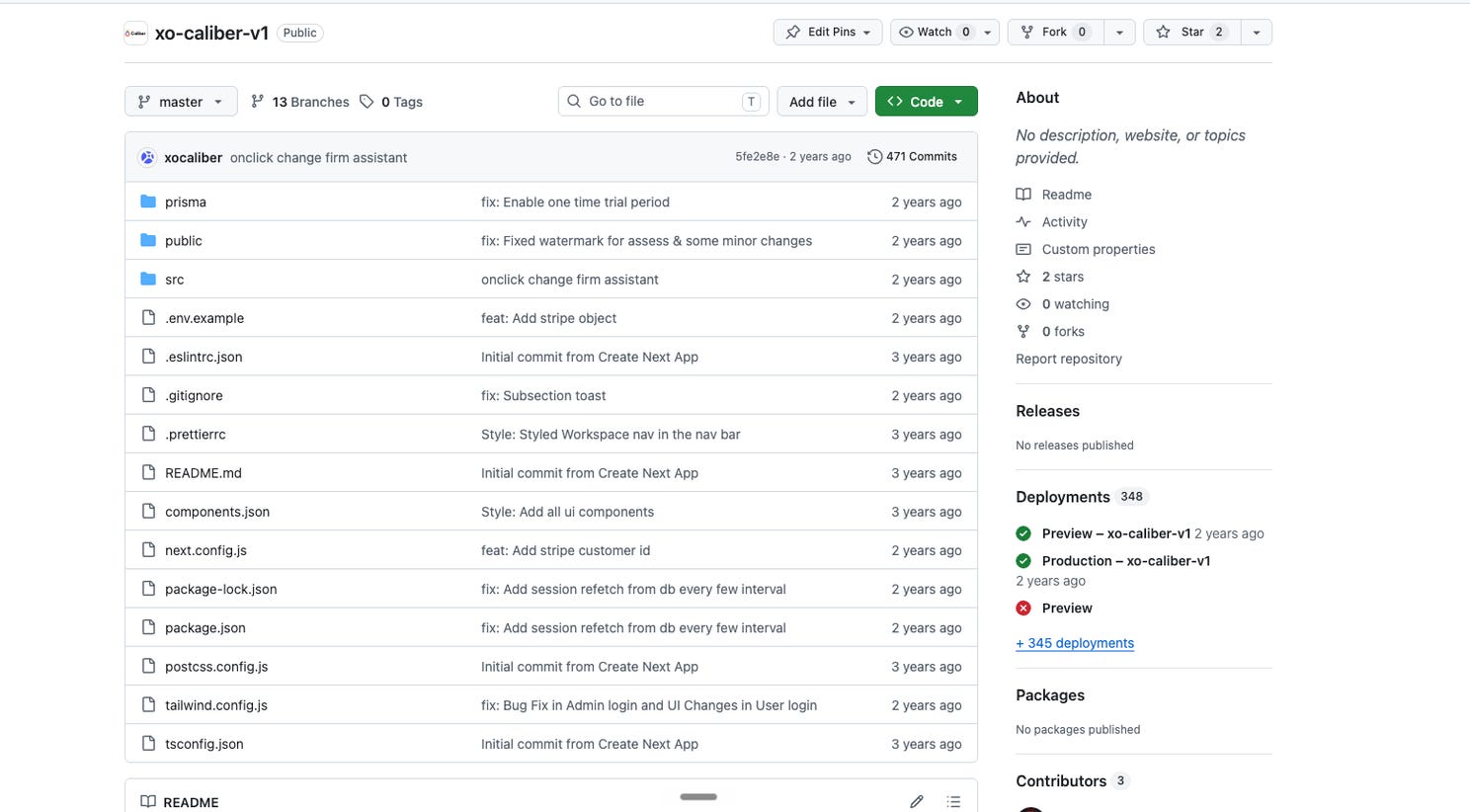
I did not want the core idea – that immigration preparation can be more structured, transparent, and fair – to sit in a private repository waiting for a perfect launch. I wanted anyone to be able to inspect it, run it, or build something better from it.
Technically, nothing I am building is impossible for someone else to build. Tools, frameworks, and AI models are increasingly available. What matters is not exclusivity of code, but clarity of purpose.
The real gap: understanding, not software
Immigration tech already has many tools. There are intake systems, case management platforms, drafting assistants, document portals, and petition generators. They make workflows more efficient, but they do not fully answer the questions applicants keep asking.
Those questions are simple and relentless
Am I eligible
Is my profile strong
What evidence do I actually need
Am I ready to file
Do my leadership, impact, awards, publications, media, or salary really matter
I had those same questions when I started my EB‑1A journey. I had achievements and documents, but no clear way to map them against how adjudication really works. I could read the USCIS policy manual, AAO decisions, and attorney articles, and still end up in the same place: “I have information, but I do not have clarity.”
That is the missing layer. Not another form. Not another portal. A layer of understanding between raw accomplishments and legal analysis.
From xoCaliber to Meritocrat
When I started building, it was under the name xoCaliber. I began immediately after my EB‑1 approval, before I received my green card and before I considered a public product. It was a personal response to a very personal pain: knowing you might qualify, but not knowing how to think about your own profile.
While xoCaliber was evolving, I saw other products like CaseBlink emerge in nearby directions. That did not discourage me; it confirmed that the problem space was real. The difference was how I wanted to approach it.
I kept xoCaliber open source and publicly available on GitHub. I did not put significant effort into self promotion. I simply left it open so anyone could read the code, spin it up, or fork it as a starting point. By the time I formally created the company and moved toward Meritocrat, I already had a live foundation and a clear sense of what was still missing.
Meritocrat as a context evaluation layer
Meritocrat is not trying to be just another intake, case management, or drafting tool. Those layers exist and will continue to improve.
Meritocrat is being built around a context evaluation layer.
The premise is straightforward: different applicants need different ways to be understood.
A business leader is not a researcher
A founder is not an athlete
An artist is not a scholar
Even within business, a C‑suite executive, engineering leader, product leader, startup founder, or industry specialist may require different context
Generic intake funnels all of them into the same questions and the same checkboxes. Meritocrat does something else.
We build dynamic profiles – for example
Business
Athletes
Artists
Researchers
Scholars
Within each profile type, the evaluation logic changes. If something is irrelevant, we do not force the applicant through it. If something is central to their case, it carries more weight. The goal is to collect context that actually matters, translate it into meaningful signals, and connect those signals to the evidence that supports them.
This creates a different kind of preparation
Applicants answer structured, profile aware questions
Their responses generate a readiness view or context graph
That view can become a report they use for self reflection or for an attorney conversation
It is not a legal conclusion. It is a preparation layer. It helps an applicant say: “Here is how my profile looks when structured against what tends to matter in adjudication. Is this ready for serious legal analysis”
Who defines “what matters”
I can design frameworks, architectures, and workflows. I should not unilaterally define the adjudication informed evaluation layer.
That is why Meritocrat involves former USCIS officers as advisors. They have seen, case by case, how evidence is read, where RFEs originate, and how patterns of strength and weakness appear in real files. Their role is not to turn Meritocrat into a decision engine, but to help anchor its context questions and signals in the reality of review.
This collaboration gives us a baseline to test evaluation modules and improve the clarity layer for applicants before they ever reach legal strategy. The aim is to help applicants ask better questions, not to answer those questions with legal certainty.
Structure before judgment
The friction between applicants and attorneys often starts here
An applicant spends months collecting documents. Then they send a folder, a drive link, or a zip file to an attorney and ask: “Can you tell me if this is helpful”
For the attorney, that can mean hundreds of documents, multiple narratives, and a complete lack of structure. Claims are unclear, context is missing, and no one has mapped which piece of evidence supports which criterion.
Meritocrat uses evaluation metadata in two ways
First, at the profile level
The applicant answers structured questions
Each answer carries a signal, such as strength, relevance, recency, or impact within their domain
These signals combine into a readiness view that is transparent, not mystical
That view can be exported as an informational report. The right question becomes: “Given this structured picture, do you think it makes sense to move into legal analysis now or later”
Second, at the document level
When the applicant uploads evidence, each file inherits context from the question or claim it supports
High impact claims demand high quality supporting documents
If the evidence does not match the claimed weight, you can see where risk begins – the places where RFEs, weak positioning, or vague narratives often arise
Throughout all of this, attorneys remain central
They define legal strategy
They decide which evidence to emphasize
They make the professional judgment call
Meritocrat’s job is to make that judgment easier by giving them clients and files that are already structured and context aware.
Applicants prepare, attorneys decide
Many applicants hesitate to contact attorneys because they fear hearing “you are not ready.” Some prefer to self study: reading AAO decisions, learning the criteria, collecting evidence, drafting their own narratives. I respect that instinct because what they are really chasing is clarity.
The moment an applicant gains clarity, everything improves
They can prioritize the right achievements
They can gather better supporting evidence
They can communicate more clearly with attorneys
They can accept honest feedback without feeling lost
Meritocrat is designed to support that moment. Applicants get a clearer sense of where they stand. Attorneys receive better organized, context rich profiles and documents. The conversation can move faster from “what do you even have” to “what is the best way to position this under EB‑1A, EB‑2 NIW, or O‑1A”
We are also building workflows around this evaluation layer – not just static forms, but guided preparation paths tuned to different applicant types and case strategies.
Open source, legal AI, and why domain focus matters
Today there is an explosion of proprietary legal AI products: platforms like Harvey, Legora, Paxton, and others are pushing what is possible in document understanding, drafting, and research. In parallel, there is a growing open source movement around legal workflows, with frameworks and community projects that make agents, librarians, and workflow fields accessible to builders who care about specific domains.
Projects like https://mikeoss.com are showing what happens when legal workflow building becomes a community effort instead of a closed box. Builders can remix patterns, adapt them, and share improvements back.
Thank you Will Chen
I want Meritocrat to live in that world. Some parts will need to be productized so we can support attorneys and applicants properly. But the spirit is the same as xoCaliber: share what can be shared, keep the system transparent where it matters, and avoid locking basic patterns of preparation behind a wall.
I am not trying to build a generic legal AI tool.
I am building Meritocrat for one very specific mission
High stakes, evidence based immigration preparation
Especially EB‑1A, EB‑2 NIW, and O‑1A profiles
With a context evaluation layer that helps applicants prepare and helps attorneys decide
Applicants prepare. Attorneys decide.
Everything in Meritocrat exists to make that handoff clearer, fairer, and more intelligent.
We recently opened early access for Meritocrat, a structured preparation workspace for EB 1A, EB 2 NIW, and O 1A workflows.
We are currently looking to connect with immigration attorneys who may be interested in joining our Attorney Connect network. This is for attorneys who would like to receive more prepared applicants with structured profiles, organized evidence, and clearer case information before initial review.
https://www.meritocrat.us/get-started
https://www.meritocrat.us/resources