I told myself something simple. Until I see this work, I will not worry about money. Of course, I wanted to make money. Everyone does. But that was not the reason I started. I wanted to build something that could help people at a lower cost.
So I built first.
Only later did I form the C corporation. Only later did I think about structure, equity, and all the things people usually obsess over on day one.
Idea, Problem, Solution
I made a mistake, but it was an important one.
I had an idea. I built a solution. Then I tried to find the problem.
That is backwards.
The right order is simple:
Idea leads to problem.
Problem leads to solution.
Solution must fit the founder.
Instead, I went from idea to solution, and only then realized I did not fully understand the problem. The real problem was lack of clarity. Not just for users, but for me as a founder.

That confusion taught me something important. A solution without a clearly defined problem will create new problems.
Bootstrapping Without Knowing It
What we were doing had a name. I just did not know it at the time.
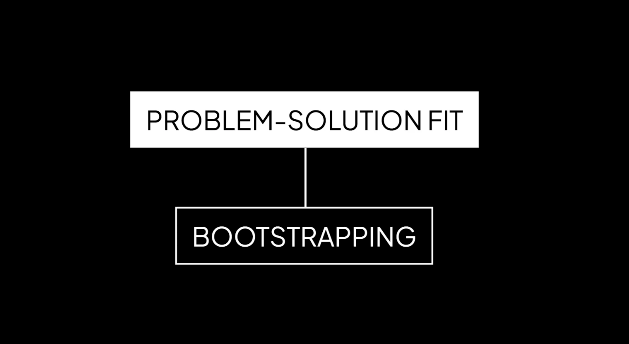
We did not invest upfront. We did not raise money. We took very small steps. We built a framework and tested it manually. Instead of scaling immediately, we worked with a few people and solved their problems by hand. And it worked. We solved three real problems manually, and all of them fit into our framework.
That was validation.
Then came the next step. If someone is benefiting, that value should not go to waste. So we started charging. That money went straight back into building the product. The founder did not inject capital directly. The business funded itself through problem solving. This is the cleanest form of validation. You are not guessing. You are proving.
Building a Team Without Realizing It
Team building is supposed to be hard. For me, it happened in an unexpected way.I helped someone manually to solve the problem. I expected that help to turn into product collaboration.
Instead, something else happened. They felt ownership. Even though I was guiding the process, they believed they were building the product themselves. That belief created commitment. And commitment is more powerful than contracts.
That is how the early team formed. Not through hiring. Through shared work and perceived ownership. Once we got to know this is not help, this is extraction, then co-founder dynamics helped us. So we moved away from them and found a new team .
Co-Founder Dynamics
I got lucky with my co founder, but it is not just luck. It is alignment.
I move fast in action and moves fast in thinking too. He slows me down in execution which sharpens our decisions. That balance works.
Because in startups, thoughts come instantly, but actions should not. Acting too fast is where most mistakes happen. Thought should always move faster than action, never the other way around, and never at the same pace.
The Shift to a C Corporation
Everything changes when you move from an LLC mindset to a C corporation.
With an LLC, money is flexible. You can put in funds, take them out, and operate with minimal friction.
With a C corporation, structure becomes real.
Every dollar has a path:
Board approval
Allocation
Spending
Re allocation
It forces discipline. And discipline becomes critical when you are building something long term.
Many founders put in their own money early. Some put in ten thousand or more. That is common. But in a C corporation, how you put in money matters just as much as how much you put in.
You need to understand:
SAFE instruments
Convertible notes
Founder loans
Capital contributions
And most importantly, you need to protect your cap table. Once it is set, you should not disturb it casually.
Money Is a System, Not a Moment
One of the biggest lessons I learned is this:
Starting a company is easy. Managing money inside that company is not.
You cannot think of funding as a single event. It is a sequence.
You invest a little.
You build.
You validate.
You invest again.
Especially in software, you are not expected to fund everything upfront. You build in phases.
But each phase requires clarity:
How much to invest. When to invest. What that investment unlocks
Without that, even a good product can fail.
What I Would Tell Founders
If you are about to start, focus on this:
Do not rush to form a company before you validate your idea.
Do not build a solution before deeply understanding the problem.
Do not spend money before proving someone will pay.
Do not ignore structure once you become a C corporation.
And most importantly, do not assume you need to know everything.
You will not. You figure it out by building, testing, and adjusting.
That is the real process.